CASE STUDY 1
Serenique Beauty & Spa
PROJECT
Serenique Beauty & Spa Branding
TYPE
Brand Identity
Design
ROLE
Graphic Designer
TOOLS
Adobe Illustrator, Photoshop, InDesign
Serenique Beauty & Spa is a wellness-focused brand offering beauty treatments in a calm, luxurious environment. The goal was to create a cohesive visual identity that reflects elegance, relaxation, and natural beauty
Primary Objective
•
Build a premium and recognizable brand identity
•
Communicate a sense of luxury, calmness, and femininity
•
Ensure consistency across all brand touchpoints
•
Create a system that works across digital and print applications
The brand needed to feel like a “sanctuary of relaxation”—not just another spa.
Challenges
Designing for a beauty & spa brand comes with specific challenges:
•
Avoiding generic “spa-like” visuals (overused leaves, clichés)
•
Balancing luxury vs. warmth (too luxury = cold, too soft = cheap)
•
Creating a system that is both Elegant and Practical for real-world use
Additionally:
The brand needed to feel premium but still approachable
The identity had to work across: Social media, print materials & gigital platforms
Design Strategy
To meet my objectives and overcome challenges, I focused on 3 core pillars:
1. Emotional Branding
The brand was positioned around:
•
Serenity
•
Self-care
•
Quiet luxury
Every visual decision supports this emotional tone.
2. Visual Consistency
System
Instead of just designing a logo, I built a complete identity system, including:
•
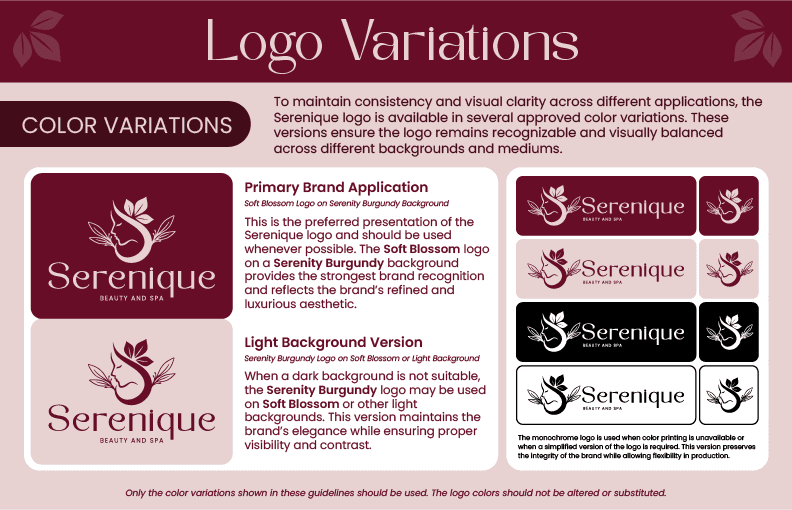
Logo variations
•
Color system
•
Typography
•
Imagery direction
3. Real-World
Application
The identity was designed to be:
•
Scalable
•
Flexible
•
Easy to apply across multiple platforms
Process
1. Research & Direction
•
Studied beauty & wellness brands
•
Identified common visual clichés to avoid
•
Defined brand personality: Elegant, calm, feminine, refined
2. Concept Development
Explored logo directions inspired by:
•
Natural elements
•
Soft curves
•
Feminine forms
The final concept uses flowing, organic shapes to represent:
•
Relaxation
•
Natural beauty
•
Renewal
3. Logo Design
The logo combines:
•
A refined wordmark
•
A graceful symbol inspired by natural forms
It visually communicates:
•
Elegance
•
Serenity
•
Premium experience
4. Color System
A carefully curated palette was created:
•
Serenity Burgundy → luxury & confidence
•
Soft Blossom → warmth & calmness
•
Deep Wine → depth & sophistication
This balance ensures the brand feels both:
•
Premium
•
Inviting
5. Typography
•
Kenao Sans Serif → headlines (elegant & distinctive)
•
Poppins → body text (clean & readable)
This pairing creates a balance between:
•
Visual personality
•
Usability
6. Imagery Direction
Defined a visual style focused on:
•
Soft lighting
•
Warm tones
•
Clean compositions
Imagery emphasizes:
•
Natural beauty
•
Relaxation
•
Premium spa experience
Final Outcome
The final result is a cohesive and scalable brand identity system, refined through multiple client revisions and feedback cycles, that:
•
Clearly communicates luxury and tranquility
•
Maintains consistency across all platforms
•
Enhances the brand’s perceived value
•
Creates a strong and recognizable visual presence




Key Learnings
•
A strong brand is more than a logo—it’s a complete system
•
Consistency is what builds trust and recognition
•
Emotional design plays a major role in brand perception
Reflection
If I were to improve this project further:
•
Expand into real-world mockups (packaging, storefront, social media)
•
Test the brand across more digital touchpoints
•
Develop a full marketing campaign concept
CASE STUDY 2
Taste 222

PROJECT
Taste 222 Menu Design
TYPE
Menu Design / Marketing Collateral
ROLE
Graphic Designer
TOOLS
Adobe Illustrator, Photoshop, InDesign
Taste 222 is a Chicago-based restaurant offering a modern American menu with a mix of comfort food and elevated dining options. The goal of this project was to design a visually compelling menu that enhances appetite appeal, improves readability, and reflects the restaurant’s premium yet approachable dining experience.
Primary Objective
•
Create a visually engaging menu that highlights key dishes and increases customer interest
•
Establish a premium yet inviting look aligned with the restaurant’s identity
•
Improve menu readability and hierarchy for better customer experience
•
Design a system that works across print and digital formats
The menu needed to feel high-end but still approachable, encouraging customers to explore more items and ultimately increase order value.
Challenges
Designing the Taste 222 menu presented several unique challenges:
•
Balancing luxury aesthetics with readability (avoiding overly decorative layouts)
•
Organizing a large amount of menu content without overwhelming the viewer
•
Ensuring clear pricing structure and item hierarchy
•
Aligning design decisions with both the Business Advisor (BA) and the client (restaurant owner) during live discussions
All revisions and decisions were made in real-time via Zoom, requiring fast iteration and adaptability.
Design Strategy
To meet the objectives and overcome challenges, I focused on 3 core pillars:
1. Appetite-Driven Design
•
Emphasized food imagery to stimulate appetite
•
Used contrast (dark background + gold accents) to highlight content
•
Positioned visuals strategically to guide attention
2. Structured Menu
Hierarchy
•
Grouped items into clear sections (Starters, Salads, Handhelds, etc.)
•
Used typography and spacing to improve scanning
•
Highlighted pricing for quick decision-making
3. Collaborative Iteration
Process
•
Conducted live Zoom sessions with the Business Advisor and client
•
The BA guided menu content and structure, ensuring business alignment
•
I provided design direction and layout decisions
•
Implemented real-time revisions for faster approval cycles
Process
1. Pre-Design & Planning
•
Reviewed the restaurant’s menu content and structure
•
Identified opportunities to improve hierarchy and visual appeal
•
Prepared initial layout directions before client presentation
2. Concept Development
Explored design directions focused on:
•
Premium dining feel
•
Clean but elegant layout
•
Strong contrast for readability
Developed a direction using:
•
Dark background for sophistication
•
Gold accents for a premium touch
•
Clean spacing for clarity
3. Live Collaboration
(Zoom Sessions)
Conducted a live call via Zoom with:
•
Business Advisor (BA)
•
Restaurant Owner (Taste 222)
Workflow during the call:
•
BA advised on menu content and structure
•
Client provided feedback and preferences
•
I adjusted layout, typography, and visual balance in real-time
4. Layout & Design
Execution
Designed a structured menu system including:
•
Clear section divisions
•
Consistent typography hierarchy
•
Balanced image placement
Ensured:
•
Easy readability
•
Visual flow across pages
•
Consistency throughout the menu
5. Refinement &
Finalization
•
Applied revisions based on live feedback
•
Fine-tuned spacing, alignment, and visual balance
•
Ensured all elements were cohesive and production-ready
Final Outcome
The final result is a premium, visually engaging menu design that:
•
Enhances appetite appeal through strong visuals
•
Improves readability and customer navigation
•
Maintains a consistent and professional layout
•
Aligns with both business strategy and brand perception
The collaborative workflow resulted in a design that is both aesthetically strong and strategically effective


Key Learnings
•
A strong menu design is not just visual—it directly impacts customer decisions and sales
•
Hierarchy and spacing are critical in content-heavy designs
•
Real-time collaboration (Zoom) can significantly accelerate the design process
•
Balancing business goals and design principles leads to better outcomes
Reflection
If I were to improve this project further:
•
Expand into real-world mockups (table menus, digital displays, social ads)
•
Test different layout variations for customer behavior impact
•
Develop a full brand system beyond the menu (signage, packaging, marketing materials)
CASE STUDY 3
Allan Domb Real Estate
PROJECT
Allan Domb Instagram Carousel Ad Design
TYPE
Social Media Ad / Marketing Design
ROLE
Graphic Designer
TOOLS
Adobe Illustrator, Photoshop
This project involved designing a high-converting Instagram carousel ad for a luxury real estate brand, focused on promoting premium properties and services in Philadelphia. The goal was to create a visually compelling, scroll-stopping experience that guides users through a clear narrative across multiple slides.
Primary Objective
•
Create a scroll-stopping first slide
•
Design a cohesive carousel flow that encourages users to swipe
•
Communicate luxury positioning and trust
•
Deliver a conversion-focused call-to-action (CTA)
Challenges
•
Designing for fast-scrolling social media environments
•
Maintaining consistency across multiple slides
•
Structuring content into a clear storytelling sequence
•
Working through a platform-based workflow (no live communication)
Design Strategy
To meet the objectives, I focused on 3 core pillars:
1. Scroll-Stopping Entry Point
•
Strong hero image featuring a luxury interior
•
Bold headline to immediately capture attention
•
Clear CTA: “Swipe to find your perfect match”
2. Narrative-Based
Carousel Flow
Each slide was structured to guide the user step-by-step:
•
Slide 1: Hook + CTA
•
Slide 2: Credibility (40+ years experience)
•
Slide 3: Lifestyle (premium neighborhoods)
•
Slide 4–5: Services & value proposition
•
Slide 6–7: Brand positioning & emotional appeal
•
Slide 8: Final CTA (DM, website, call)
This creates a clear and conversion-focused user journey.
3. Premium Visual
Identity
•
Deep navy + gold palette → luxury & trust
•
Elegant typography → high-end positioning
•
Clean layout → readability and clarity
•
High-quality imagery → aspirational appeal
Process
1. Brief & Platform-Based
Request
•
The client submitted the request through the process platform
•
Included content, direction, and preferred format (1080 × 1440)
•
Reviewed and structured the content flow
2. Initial Design Execution
Designed the full carousel with:
•
Strong hierarchy
•
Consistent branding
•
Clear storytelling structure
3. Revision Cycle
(Platform Workflow)
All feedback and instructions were received via the platform.
Completed 2 revision rounds, including:
•
Content adjustments
•
Layout refinements
•
Typography and spacing improvements
Typography and spacing improvements
4. Finalization & Delivery
•
Refined all slides for consistency
•
Optimized for Instagram
•
Uploaded final output through the platform
Final Outcome
The final carousel ad delivers:
•
A strong visual hook that captures attention
•
A structured and engaging narrative flow
•
A premium brand presentation aligned with luxury real estate
•
A clear and effective call-to-action system
The result is a design that balances visual appeal and marketing effectiveness.


Previous
Next
Key Learnings
•
Carousel ads are most effective when designed as a guided story
•
Strong hierarchy improves user engagement and readability
•
Clear communication is essential in platform-based workflows
•
Consistency across slides strengthens brand perception
Reflection
If I were to improve this further:
•
Test variations of the first slide for higher engagement
•
Explore motion-based carousel designs
•
Optimize layouts based on performance data
•
Expand into a full campaign system (ads, landing pages, retargeting)